After the success of the 1990’s biographical film The Doors, interest in The Doors grew. This is clear from the previous entries in the music project featuring the Doors. I watched The Doors starring Val Kilmer as Jim Morrison at Beanhead’s house while his folks were away. Several of us gathered there and watched the film, some experimented with herbal substances, while others continued dabbling with alcoholic substances.
I will always remember that evening for the enlightenment it brought to me as a youth. How music remains the common key that joins us and how sometimes there are people who, through music, touch us in a special way. Furthermore, I also realised that evening, that I had seen Jim Morrison in a documentary having a plaster cast made of his penis.
These kinds of things linger in the mind. Like a nasty fart in an enclosed room.
Anyway, to celebrate the launch and revived interest in The Doors, the remaining members of The Doors rereleased this, the bands first album, to capitalise on the success of the film. Unfortunately, The Doors provides nothing new. Nothing new will come from The Doors ever. Unless you can reanimate Jim Morrison. Never the less, constant releases of compilations and Best ofs will surely squeeze a tiny little drop of something out of the Jim Morrison bandwagon. Hey, perhaps it’s time to release yet another film about The Doors….We could do with another “best of” about now…
Once again, as previously discussed, the Pixies are only here in my collection because I’ve been told that I “should” like them.
When I said to my self appointed and styled music guru hipster friend that I had obtained the Pixies’ best of compilation, the snort of contempt was akin to a field of hippos.
“You shouldn’t get the best of” he said, “It is a poor reflection of their musical superiority and genius. Instead why not get Doolittle which is the definitive album for those who should like the Pixies.”
So apparently this is the definitive album for those that “should” like the Pixies. Now, as any logic professor will tell you, as I don’t like this album I am not someone who “should” like that band.
I missed Donnie Darko on the cinema. First time I knew of its existence was when I saw it on the shelf in the Rialto News video library on Upper Parliament Street looking unloved.
Watching the film had me transfixed in a way a film hadn’t had me transfixed since Lost Highway. Here was a film that was so intricate that one viewing would not suffice. Several viewings would be needed and so, as it should be, I nipped into HMV and treated myself to a copy of the film on DVD. I went round telling people that this film was one they should watch and digest, a suggestion that was met with the usual dismissive shrug.
Since then, the film had an almost viral spread. Months would pass and the people I suggested the film to would say to me “Hey, have you ever seen Donnie Darko?” excited by the prospect that they may have seen something enlightening that would appeal to me before me. Then people started talking about it in the mainstream press, on the mainstream television, even a song from the soundtrack, the Michael Andrews version of Tears for Fears’ Mad World reached number 1 in the UK.
The film, previously a slightly unknown cult movie, was rereleased to capitalise on its growing success with a Director’s cut. Unfortunately, the directors cut didn’t add anything to the original apart from time. In fact it watered the content down if anything. Made it easier to digest and over explained bits that didn’t need explaining. Then there was the sequel, S.Darko but we don’t talk about that. In fact, let’s not even admit to it existing…
Still, like all good capitalists the owners of the film rights released an extended version of the soundtrack too and today’s album is that very same. The soundtrack features a number of popular contemporary songs from the time in which the film is set interwoven with nice hauntological piano led intermissions. The original soundtrack release featured less of the plinky plonky and focussed more on the atmospherics and contemporary sounds than this version. Still good though.
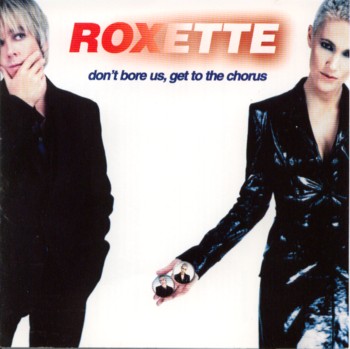
More Europop, this time with late eighties popsters from Sweden, Roxette.
You might recall Roxette from such hits as Joyride, Listen to Your Heart and Must Have Been Love. I did. I remembered how much I liked their songs and realised, mid noughties, that I had none of their albums. So with copious amounts of internet to consume, I set about downloading their Best of compilation and this is it.
All their hits from 1988 through to 1995 are here including those already mentioned, The Look and Dressed for Success. Re-listening to the album for the purpose of the music project just kept shoving me into a mental Delorian back to my youth in the late eighties and early nineties.
German new wave rock star Joachim Witt emerged onto the world stage roughly around the same time as Falco but it wasn’t until the nineties when his hit Die Flutt was rereleased as a duet with Peter Heppner that his international recognition was ignited.
Witt has appeared on the Music Project once before with his best of compilation album Auf Ewig and his eighth album Bayreuth 1 and I’ve already hinted that the only reason I had any of these albums was because of Die Flutt. But DOM is included in the collection purely because of the song Gloria which I came across when trying to find one of Witt’s music videos.
Sadly, this is the last time Witt appears in the Music Project on his own, later appearances are purely due to his inclusion in compilations. While Eurorock continues to run a vein through the mine of my music collection with German and Austrian artists appearing like nuggets of growly goodness, the genre and style which Witt is a part of is certainly one I would like to explore further. But here is the other song I like by Witt a cover version of the song Battalion d’Amour by East German band Silly.
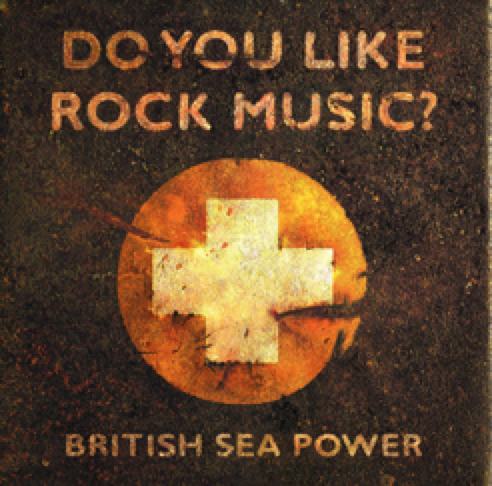
I have to admit that when I started writing the music project, British Sea Power were a band I’d heard snippet of and thought pretty much “Meh”. However, during that time and following the amazing film From the Land to the Sea Beyond I’m a convert. I can hear what they are trying to convey and I totally “get” them.
Even if how I “get” them differs from how they, the band, want people to “get” them. Aurally, to me at least, they are the orange rust smeared metal columns sticking out of the disturbed North Sea of British noughties music and are awesome at doing it too.
We’ve met British Sea Power before on the music project, with their debut The Decline of British Sea Power. However, Do You Like Rock Music? is totally a great starting place for someone coming fresh to the band, indeed, many of the tracks on the album reappear in the film From the Land to the Sea Beyond. British Sea Power might not be everyone’s choice of sound but if you like your music salt encrusted and flavoured with centuries of coastal industry and deprivation, then I suggest you give them a try.
Thanks to Steelrattus for looking after the shop while I had a holiday. It’s always fun to see read other people’s insights into the music in my collection and, as long term readers will testify, there has been rather a lot up to this point and there is far much more to follow. The Music Project is a labour of love, one which I do for fun and it’s a great opportunity and fun challenge for writers to dip into. Which is why new writers are always welcome here.
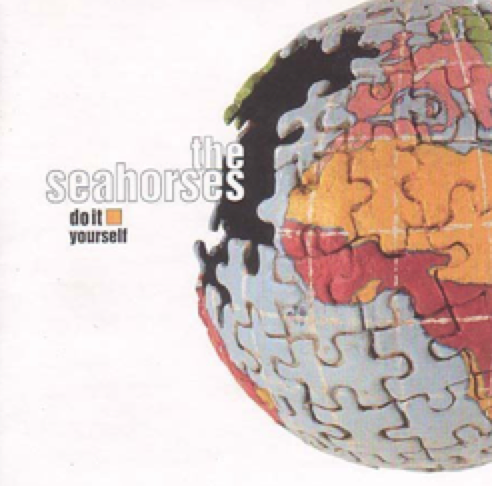
Mostly though I do it myself. Doing it yourself was pretty much the buzz of the nineties. On the back of the likes of Ground Force and DIY SOS, the popularity of nipping down to B&Q at the weekend for a bag of nails and some 2-b-4 grew. Sadly so did the popularity of the Seahorses through the use of the term Do It Yourself in this, their first album. Continuity has never been my strong point.
Anyway, I’d never heard of the Seahorses.
So imagine my surprise when a the happy age of midtwentysomething a senior work colleague who I happen to have said good morning to while passing in the corridor everyday for several years returned the greeting to me one morning with a copy of this CD thrust into the palm of my hands.
“You SHOULD like this” he said, “It’s right up your street”.
How the jiggery Thomas he could conclude this from a mere, “Hi!” or cheery “Morning!” as we passed in the dusty corridors of St Annes house in Bootle, I have no idea. None the less, it sat for years more on my book shelf through 3 house moves before being ripped and placed into the box marked “Music Magpie“.
Shortly before the fourth house move, my then wife discovered it and exclaimed how much joy the band brought her and then proceeded to play it most days on her car stereo, come home from work whistling or singing the songs and generally liking the album altogether.
Personally, I couldn’t stand it. Sure it has all the elements of “indie” nineties and screams Oasis and Shine but there’s nothing unique about the sound.
Still, it’s still in my collection. I still have no idea why and the only time I’ve listened to it in its entirety was for the purpose of this music project. It now resides in a folder labeled “Recycling Bin”.
Steelrattus here again, with the last of my guest posts in this seven day run. And a great album to finish on, coincidentally, for me at least.
The Division Bell is the second of the two albums that I actually know quite well, or at least I’ve listened to it a lot. It’s another album that dates back to my time at university, Surrey University to be specific. <Anecdote>Along with the aforementioned wonderful UniversityRichard™ who introduced me to lots of music, I had another friend called Simon Levy. I will admit I was a bit of a twat towards Simon, to begin with. I felt like Simon was trying to muscle in on the small clique I was a member of, and being of low self esteem I didn’t like it, and didn’t really know better. But despite the frosty start I did eventually warm to Simon. Much like Richard he was a “music pusher”, albeit on a much smaller scale. Simon only pushed me towards two artists, Pink Floyd and Roger Waters. I remember Richard being quite wary of Pink Floyd, specifically The Wall, for which he’d give me a there-be-dragons-here look when I mentioned it. Anyway, I consumed the tapes that Simon recorded for me, and enjoyed them. I graduated in 1995, and The Division Bell was released in 1994, so it just crept in prior to the end of my degree.</Anecdote> To this day I remain a definite Pink Floyd and Roger Waters fan, with a caveat. I’ve been lucky enough to see The Wall live, twice, and I now have a much better understanding of Richard’s there-be-dragons-here look; it’s a hard hitting album if you grapple with its story. I also have a debt of thanks to Simon for the introduction, but sadly along with being an idiot when I first met him I was also an idiot and lost touch with him post-university, and have never been able to find him since to at least say, “thanks… and sorry”.
The Division Bell comes from what I describe as third generation Pink Floyd – I’m not sure if these are official designations, but they work for me. I see first generation Floyd as their early 60s psychedelic stuff with Syd Barrett, and that’s where the caveat comes in because I don’t like this era at all. Second generation Floyd I identify with Barrett’s departure, although I don’t think they hit their stride until Dark Side of the Moon. Third generation Floyd follows the departure of Roger Waters in 1985. There have only been three albums post-Waters, of which this is one. The music from this phase can be very… nice, but the albums lack the bite that Waters added to varying degrees, and at times feels they feel positively anaemic. I do enjoy both A Momentary Lapse of Reason, the first of the albums without Waters released in 1987, and The Division Bell, even though they’re both a mixed bag. I even have a karaoke version of Coming to Life, from The Division Bell, but it’s bloody hard to sing.
An interesting fact that I didn’t know is that the album name was suggested by Douglas Adams, apparently over dinner and in return for a donation to his favourite charity. It can’t have required much effort though as it was a lyric from one of the tracks on the album, High Hopes.
Steelrattus here again, with the sixth of my guest posts in this seven day run.
The Ditty Bops is the second of the two albums in these seven days that I don’t know at all. Again I have done the right thing, sat down, and listened to it. First impressions are contemporary bluegrass. Unfortunately this is a bigger problem than the previously reviewed album, as this isn’t my type of music at all. As an aside, of late I’ve started listening to Radio Paradise, and although it’s pretty eclectic it also has too much in the way of both country and western for my tastes. Anyway, the album is a similar sound throughout, albeit a couple of tracks seem slightly more pop-y.
A fact check unearths that this is their first album, released in 2004. They’ve released four albums subsequently, have had their tracks played in TV programmes, and featured on a Bob Dylan album.
Steelrattus here again, with the fifth of my guest posts in this seven day run.
Disraeli Gears is the first of the two albums in these seven days that I don’t know at all. So I have done the right thing, sat down, and listened to it. First impressions of the album are that it’s all very 60s/70s hippy culture. I quite liked the opening track, and the second track was famous enough for me to recognise it, but then it went slowly downhill from there. Part of the problem is that for the last few years I’ve struggled to listen to whole albums unless (a) I really like them and (b) they have some variety. Unfortunately this album doesn’t tick either of those boxes for me.
Checking the facts, the album was indeed released in 1967, hit No. 5 in the UK chart, and was Cream’s US breakthrough. The odd title is a malapropism (what I know as an “eggcorn”) between members of the band talking about a bicycle. They found it so funny they used it as the title. And here’s the famous track.
Steelrattus here again, with the fourth of my guest posts in this seven day run.
Oddly, I’ve already encountered this album twice in the last week. Firstly, it was mentioned in the latest episode of Mr. Robot. Secondly, it features in a bizarre scene in the film Ant-Man. If I were superstitious I’d probably cross myself with a black cat as this is the third time the album has crossed my path this week. But I’m not superstitious, so I shall just marvel at the coinsequences.
Disintegration is one of the two albums in this seven day stint that I am already familiar with. <Anecdote>1989. I was at Sixth Form College, probably my happiest time while being edumacated. Finally I was surrounded by intelligent charismatic peers. The only problem for this historic recounting is that I’m not certain how I ended up buying Disintegration. I do remember that there was a guy in the year above us who I locked onto, from a distance, as a bit of a role model. He was classic-80s-guy, with a chiselled jaw, and blow dried Don Johnson hair. And I remember him wearing Cure t-shirts, which seemed at odds with his look. So it was perhaps due to this guy and curiosity that I ended up buying the CD – yes, I had owned a CD player for 1-2 years at this point, and this must have been one of a few albums that I owned by 1989.</Anecdote>
I still feel much the same when I listen to the album as I did when I first listened to it all those years ago, and was blown away by the sound. The album opens with the epic and strident Plainsong, with its rumbling powerful sound. This then launches into the heartbreak of Pictures of You, which became a “favourite” breakup song of mine. There are echoes of Plainsong in Closedown, another dark powerful song. This is followed by the much more upbeat Love Song – yes it is, listen to the lyrics – although The Cure somehow still seem to make love sound mournful. Then seemingly back to darkness again with the much more abstract Last Dance. This is followed by the most famous of the tracks on the album, and arguably The Cure’s career, Lullaby, which is more abstract again, and clearly not drug influenced. For me at this point the tracks begin to blend a bit, with the dark sound of Fascination Street, Prayers for Rain, The Same Deep Water as You, Disintegration, Homesick, and finally the close out track Untitled. This is not to belittle these tracks, they are all excellent, but just don’t stick as individually in my mind as those that are earlier on the album. They almost feel like a themed B-side, although I’m not sure offhand whether they would have been the literal B-side to the album.
As a sufferer of depression, Disintegration feels like the quintessential depression album… my quintessential depression album at least. I can’t think of an album that oozes depressive feelings quite like this album, and I have to be careful listening to too much of it, particularly the latter half as it can crash my mood. It’s no surprise that Robert Smith, the lead singer, lyricist, and co-producer, was suffering from depression and a crisis-of-age at the time the album was written. This aside from problems within the band. Despite this though I feel the album is a work of genius from a band that was at its peak.
Steelrattus here again, with the third of my guest posts in this seven day run.
Mike Oldfield. I first got into Mike Oldfield at university, courtesy of the previously mentioned UniversityRichard™. It was Oldfield’s original sound which hooked me, along with the other bands that Richard introduced me to. I must have heard the titular track from Tubular Bells prior to this time, but finally I heard the entire album, and many more such as Hergest Ridge, Ommadawn, Five Miles Out, Crises, and the wonderfully nutty Amarok. While at university in the early to mid 90s Tubular Bells 2 and The Songs of Distant Earth were released. And that was pretty much where my relationship with Mike Oldfield ended. I have listened to some of what he has produced subsequently, but none of it has hooked me like the earlier albums.
Discovery is another of these odd albums which somehow I’ve managed to miss in the chronology, as it was released after Crises in 1984. I’m guessing though that the reason I’ve not heard it is because it’s not very good. Curiously the biographical section of Mr. Oldfield’s Wikipedia entry, presumably curated by one or more dedicated fans, doesn’t mention it at all. Does this also suggest that generally it’s not viewed very favourably? There is a short dedicated page for the album though which tells us it was recorded as a follow up to the very successful single Moonlight Shadow, from the Crises album. To that end, and unusually for Mr. Oldfield, most of the album is comprised of short songs that were presumably intended for the pop market, and a lot of the songs feel like variations on the Moonlight Shadow theme. The only exception is The Lake, the final track, which is a distinct instrumental that is three times the length of the other tracks on the album, and for me at least the stand out track. Oldfield has said this final track was inspired by Lake Geneva, as he recorded the album in Switzerland (he was living there for tax reasons), and could see the lake from his recording studio.
Me again. Here I am with the second of my guest posts, in this seven day run.
ELO. I have an odd relationship with ELO. <Anecdote> In the early eighties, when I was on the cusp of being a teenager, my Mum was an Assistant Librarian. This meant I visited the library a lot, and along with reading a lot of books, it also meant I got to borrow cassettes (and later CDs) for free! In turn this meant I got the chance to experiment with a lot of music without paying a bean – if I liked the cover of an album I’d borrow it. I suppose it was a bit like the music subscription services of more recent times. Anyway, one of these experimental albums was by ELO. Not the titular album I’m afraid, another album called Secret Messages. I was smitten by it, with its weird blend of multitrack vocal, orchestra, and original sound. It’s one of those albums that will forever be burned in my memory. For good or for bad it’s also forever associated in my mind with the Moomin books, which I was reading a lot of at the time. Anyway, getting back to the odd relationship bit. You would have thought that my love of the album would have lead me to listen to more ELO, but oddly it didn’t. The exact reason why is lost in the mists of my faltering memory, perhaps there weren’t any more ELO albums at the library, I wasn’t open-minded enough, or just didn’t think of it. </Anecdote>
Anyway, to present day, and it’s quite an odd thing breaking my second-ELO-album virginity. Discovery goes through all the right motions. It sounds a lot like Secret Messages and does a good job of treading that fine line between not being a copy, yet not being too different to confuse the listener. Yet it does nothing for me. Perhaps it’s too similar. Or I need to listen to it again. Music is a fickle beast. *shrugs*
For fact fans, it transpires that Discovery actually pre-dates Secret Messages by 4 years, with the former released in 1979, and the latter in 1983. Discovery was ELO’s first number one album in the UK. Oddly Wikipedia doesn’t give much if any information about how the album came together.
Here’s the opening track. Make your own mind up, if you’ve not heard it before.
Hello again. It’s Steelrattus here with the first of seven consecutive guest posts. This time around I am helping Stegzy out for a whole week, so I have essentially got whatever seven albums are scheduled for this week. So this is why I’m utterly blameless for the first of these posts.
The Dirty Dancing soundtrack. I’m not sure I have ever seen the film. In fact my only real memory of the film is my sister being a huge fan back when it must have been at the cinema in 1987, and subsequently home cinema. But in the interests of… science (and blogging) I have forced myself to listen to the soundtrack. For review purposes I appear to have the 20th Anniversary Edition of the soundtrack, which is twenty seven tracks versus the 1987 original edition’s twelve, to add insult to injury. So the beers that Stegzy owes me have just increased I feel. By an order of magnitude.
The soundtrack itself appears to be a mix of 1950/60s rock and roll, reflecting the 60s setting of the film, and 80s power ballads. I don’t mind the 1950/60s tracks so much, but the 80s stuff doesn’t do so much for me. Listening to the album it all tends to bleed together. And that’s about all I’ve got to say about the music.
For fact fans, apparently the original 1987 soundtrack was a huge success, sold 32 million copies worldwide, and is one of the best-selling albums of all time, proving there is no God. Apparently it spent 18 weeks at number one in the US Billboard chart. Its performance spawned a follow-up called More Dirty Dancing in 1988. Ultimate Dirty Dancing was released in and contains every song in the order played in the film (great for OCD nuts like me… well it would be if I would ever listen to it. Which I won’t. Ever). It transpires that the version I’ve listened to, the 20th Anniversary Edition (unsurprisingly released in 2007), contains remastered and additional tracks in a different order. *shrugs*
Anywhere, here’s the obligatory YouTube video, of what is presumably the most popular track.
Another band I was told I “should” like but don’t. Frankly, I think the only reason I have such a John Peelesque collection of digital music is because people tell me that I “should” like something.
Northern folk rock referencing the experiences of a generation now approaching middle age.
Different Class is the album which most people identify with the band. Gritty cutting social commentary enhanced by Cocker’s unique singing style. Many of the tracks appear on a variety of soundtracks of the time.
Even though I lived in Sheffield at the height of their popularity and I met Jarvis when he popped into the Halfords I worked in, at the time I didn’t like them, but persistent gnawing at my ears and gradual realisation of the talent behind the music arose to change that perception and sentiment.
If you didn’t know, and I didn’t, the White Rose, or the Die Weiße Rose, were a German resistance movement against the Nazis during the second world war. Their activities are largely unmentioned in popular history which is a great shame as their story is one that fills me with ire and pity. There are even a number of European films that tell their story which are well worth a watch when you’re feeling at peace with the world. [For more on the White Rose see – https://en.wikipedia.org/wiki/White_Rose or see the film – https://en.wikipedia.org/wiki/Sophie_Scholl_–_The_Final_Days].
Die Weiße Rose is also an album by old music project entrants Le Joyaux de la Princesse. You might remember them for their Croix de Boisand their collaboration with Blood Axis. This is by far their most poignant album to appear in the music project yet. Perhaps it is because I know the history of Die Weiße Rose and how the music makes a fitting artistic aural narrative to their story, or perhaps it’s because the true terror of a fascist nationalist government still remains in my lefty socialist mind.
I suggest a listen to this album in a book lined study with a strong drink and a packet of German cigarettes.
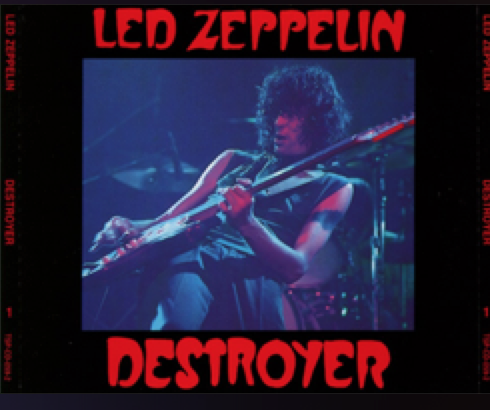
Destroyer is a bootleg recording of the band’s gig in Ohio 1977.
As I’m not a fan of the band and the only explanation for why it’s in my collection that I can think of is that it was “given” to me by someone who thought that I “should” like Led Zeppelin (I actually like a couple of their songs but find them a little too mainstream for my tastes), all I can say about it is “Yes. It’s in the collection. For now.”
Good old Jim will probably frown at this but I find Kiss’ Destroyer a little kitsch for my tastes.
I’ve known about Kiss since I was young enough to fall over a concrete post underneath the school hall upon which the words “Kiss” and “Rush” were written in permanent marker. People who say graffiti doesn’t affect anyone should pay note to the fact that even at the grand old age of 42 I still clearly remember that concrete post and the graffiti on it. I also remember the Ajax bottle sized crapily drawn cock on the side of the neighbouring concrete post.
Perhaps that comically drawn phallus was a foreshadowing for the lyrics on this album. Yes, I can see the appeal for Kiss and their glam rock sentiments but in a post-1970s world I find it difficult to identify any lasting sentiment for the band other than a squiggle on the side of a post and Jim’s own lasting sentiment for the band.
If ever there was a soundtrack in the late nineties early noughties you could probably bet ten bob on it featuring good old baldy bonce Moby. It was like you couldn’t listen to anything without it having had some Moby influence.
Moby moby moby.
I followed the herd and eventually grew to love his quintessential Play and I suppose I’ll take my hat off to his I Like to Score but by 2004 I’d got bored with him. I suspect the rest of the world did too because his later albums, Hotel, 18and today’s album Destroyed haven’t been played to death by people looking for music for their film/documentary.
Destroyed is a bit bollocks. Much like Jarre, Moby becomes a bit common place and because of this there is nothing new or innovative. Destroyed is Moby pure and simple but it’s a tired Moby. An “I’ve got to release this album because I’m contractually obliged to” Moby. I imagine that the reason he titled the album Destroyed is because it is a reflection on his ability to produce something new.
Still, I’m sure he’ll do what Mike Oldfield did and reappear with something spectacular after a few years of nothingness.
For someone who isn’t a fan of French electro musician Jean Michel Jarre, I seem to have a fair few of his albums.
This is the album of the performance that my brother told me that I should watch when it was on the telly because ancient law stated that I must like Jarre. It was the same brother that insisted that it was a once in a lifetime futuristic event because Jarre would be playing laser harps and in the future we would all be playing laser harps. Playing laser harps and going to the moon on holiday with our jet packs.
Nearly 27 years later we’re still waiting for laser harps, jet packs and holidays on the moon. Instead I settle for driving to Wales on my holiday in my Golf with my musical instrument of choice the human body (mine). Jarre on the other hand is pretty much the same.
See I like Portishead. I am particularly fond of their first album Dummy and their third album Third but the second album proved illusive to me until relatively recently.
The reason for this was because, following release, I was told “It’s shit” and “It’s not as good as the first one” by music loving friends of mine whose musical knowledge I once respected.
Of course many years passed following the release of Dummy and trips to HMV waned due to the availability of music through the likes of Amazon and file sharing. Indeed, many years would also pass until the release of Third but that’s a different story.
So when it came about that the internet was the gateway to all the music ever I set about to find the second album. Of course Wikipedia was in its infancy, the web was a bit shit and I had difficulty actually finding the second album. Probably because lots of people also had friends who told them that Portishead’s second album was shit.
To find the album I did what anyone else would do; search on newsgroups for the keyword “Portishead”. It was during this first search I found a wealth of different versions of Dummy as well as compilations featuring the band. I also came across this album, Desolation Row.
Desolation Row is a bootleggy fan compilation of live-ish performances of the band including Later with Jools Holland, Glastonbury (recorded off the radio by the sound of it), some French gig and a studio rehearsal. Mysterons appears twice and so does Sour Times and it’s kind of a low budget version of Dummy with a few extra tracks. Not a good place to start to get into the band really. My suggestion is to stick with Dummy and listen to it on the worst media playing system you have instead.
We’ve met Sheffield violinist Matt Howden in his alternate guise of Sieben on the Music Project before. This was the first album I bought by Sieben having previously only heard the artist on the Looking for Europe neofolk compendium.
On this album Howden shows how his cheeky humorous side can be laced through his biting observational reflections on various aspects of life. From how the far right have propagated their disgusting agenda through some neofolk to the story of a besotted lonely projectionist, Howden uses this album to set the foundations for his later albums.
If you are new to the neofolk scene, especially the small presence within the genre of British artists, the talented Sieben/Matt Howden’s album Desire Rites is a nice intro.
This is a bootleg from a concert in the series I saw Yes at in 2002. I then saw the band one last time a year later I think.
I grew up with Yes. They have a special place in my heart and mind as well as a place in my music collection. Sadly long time member and bassist, Chris Squire, passed away earlier this month so it is unlikely I will get to see the band again. I have read that Squire’s old pal Billy Sherwood of Squire/Sherwood collaboration The Unknown has stepped up to cover the massive Chris Squire hole in the band. Moreover, lead singer Jon Anderson is also no longer with the band, Rick Wakeman pops in and out, Steve Howe must be pushing 934 and Alan White is looking a bit tired these days too. It remains hard to imagine how long the band will continue without Chris in the engine room.
 After the success of the 1990’s biographical film The Doors, interest in The Doors grew. This is clear from the previous entries in the music project featuring the Doors. I watched The Doors starring Val Kilmer as Jim Morrison at Beanhead’s house while his folks were away. Several of us gathered there and watched the film, some experimented with herbal substances, while others continued dabbling with alcoholic substances.



 The Division Bell – Pink Floyd
 The Ditty Bops – The Ditty Bops
 Disraeli Gears – Cream
 Disintegration – The Cure
 Discovery – Mike Oldfield
 Discovery – ELO
 Dirty Dancing – OST



 For someone who isn’t a fan of French electro musician
![Desire rites - Sieben [#363]](https://stegzysmusicproject.com/wp-content/uploads/2015/07/screen-shot-2015-07-27-at-19-14-52.png)


 Stegzy's Music Project